
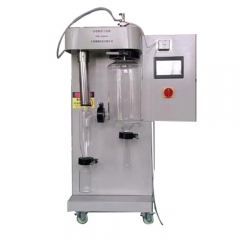
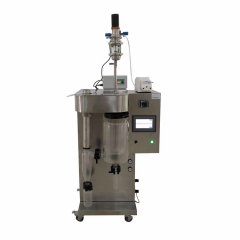
Hochwertige 1,5-Liter-Labor-Sprühtrocknerausrüstung
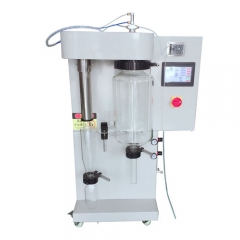
Sprühtrockner im Labormaßstab eignen sich für die Produktion von Universitäten, Forschungsinstituten und Lebensmittel- und pharmazeutischen Chemieunternehmen.
In rubber and polymer material R&D, consistent roller surface temperature directly determines the repeatability of mixing tests and the reliability of final sample properties. Two roll mill has integrated fully-integrated electric heating and closed-loop water cooling delivering a complete thermal management solution for diverse material research scenarios.
The roller adopts an embedded electric heating architecture. Axial heating elements are installed inside the high-carbon steel roller body, powered through the drive-end electrical connector. This direct core-to-surface conduction ensures uniform temperature distribution across the entire working face, eliminating the hot-spot defects common with external heating systems.
Paired with screw-in thermocouples and PID closed-loop control, the system achieves a temperature accuracy of ±1~2°C and a maximum working temperature of 300°C. It preheats rollers rapidly from cold start, shortens material plasticizing time, and maintains stable process temperatures for PVC compounding, color masterbatch dispersion, polymer blending, and high-temperature vulcanization trials — significantly enhancing R&D efficiency and batch-to-batch consistency.
Complementing the heating function, the roller is engineered with internal circulating water cooling channels. During rubber mixing and high-shear processing, continuous mechanical friction generates excess heat that can cause compound scorching or premature vulcanization, permanently damaging material properties.
The water cooling system automatically circulates cooling water through the internal flow channels to rapidly remove surplus heat, keeping the roller surface within the optimal 50~90°C range for rubber processing. In addition, low-temperature circulation reduces thermal stress on bearings and transmission components, alleviating thermal wear and extending overall equipment service life. For laboratories testing multiple material types, the cooling function also enables fast temperature switching between high-temperature plastic trials and low-temperature rubber processes, making the mill a versatile workhorse for Research and Devolopment labs.



 +86 15960821529
 kevin@ollital.comkevinollital@gmail.com
 +86 15960821529
 +8615960821529


