
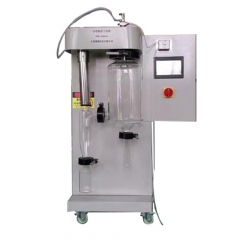
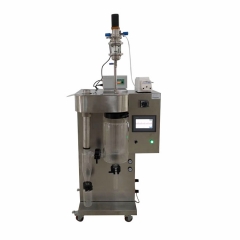
High quality 1.5L scale lab spray dryer equipment
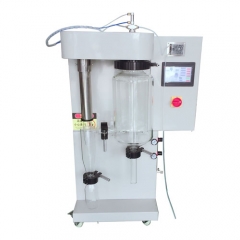
Lab scale spray dryer is suitable for the production of in universities, research institutes and food and pharmaceutical chemical enterprises.
Injection molding machines are designed to melt plastic materials and inject them into molds under controlled pressure. Although horizontal and vertical injection molding machines follow the same basic molding principle, their mechanical structures and component arrangements are different.
Understanding these structural differences helps users identify how each machine operates, how the mold is installed, and how the injection and clamping units work together.
Both horizontal and vertical injection molding machines consist of several essential components:
Injection Unit: Includes the hopper, screw, heated barrel, nozzle, and drive system. Plastic pellets enter through the hopper, are melted inside the heated barrel, and are injected into the mold.
Clamping Unit: Consists of the fixed platen, moving platen, mold-closing mechanism, and associated drive components. It holds the mold closed during injection and opens it after cooling.
Heating System: Controls the barrel temperature to ensure that plastic materials reach the required melting condition.
Drive System: Provides the mechanical power required for plasticizing, injection, mold opening, and mold closing. Depending on the machine design, it may use hydraulic, electric, or servo-driven systems.
Control System: Allows operators to set and monitor important molding parameters, including temperature, injection speed, pressure, and cycle time.
These components work together to complete the injection molding cycle, but their physical arrangement differs between horizontal and vertical machines.
In a horizontal injection molding machine, the mold-clamping unit is arranged horizontally. The fixed and moving platens face each other along a horizontal axis, allowing the mold to open and close horizontally.
The injection unit is generally aligned with the mold's injection axis. Plastic material is fed from the hopper into the barrel, where the screw melts and conveys it toward the nozzle. The molten plastic then enters the mold cavity.
The main structural characteristics include:
Horizontal Clamping Layout: The mold opens and closes along a horizontal direction.
Horizontal Injection Unit: The barrel and injection mechanism are generally aligned with the mold.
Platen and Tie-Bar Structure: These components support mold installation and guide the movement of the clamping unit.
Ejection Mechanism: Pushes the molded product out after the mold opens.
Base and Frame: Support the injection and clamping systems.
This arrangement is widely used in conventional industrial injection molding equipment and various laboratory models. For example, OLLITAL's Horizontal Type Plastic Spoon Injection Molding Machine integrates mold-clamping components, injection components, a heating system, a control system, and a feeding device into a compact machine structure.
A vertical injection molding machine generally features a vertically arranged clamping unit, with the mold opening and closing along a vertical axis.
In a commonly used configuration, the mold is installed on vertically positioned platens. The injection unit is arranged vertically or integrated according to the machine design, allowing molten plastic to enter the mold through the corresponding injection path.
Its main structural characteristics include:
Vertical Clamping Layout: The mold opens and closes in the vertical direction.
Vertial Mold Installation: The fixed and moving mold sections are arranged vertically.
Injection Unit Arrangement: The injection unit may be positioned above or integrated with the clamping structure, depending on the model.
Supporting Frame: Provides structural support for the vertically arranged assembly.
Control and Drive Systems: Coordinate injection, mold movement, and the molding cycle.
Some vertical designs also allow inserts to be positioned in the mold before injection, making the structure suitable for specific insert-molding processes.
It is important to note that vertical injection molding machines do not all use exactly the same injection-unit arrangement. The actual structure depends on the machine configuration.
Although both machine types contain similar functional components, their physical layouts create several differences.
| Structural Aspect | Horizontal Machine | Vertical Machine |
|---|---|---|
| Clamping direction | Horizontal | Vertical |
| Mold opening | Horizontally | Vertically |
| Mold arrangement | Horizontal platen layout | Vertical platen layout |
| Injection unit | Generally horizontal | Depends on configuration |
| Mold loading | Access from the side/front, depending on design | Often convenient access from the front or above |
| Installation footprint | Generally requires more horizontal floor space | Can reduce floor-space requirements |
| Insert positioning | Depends on mold and handling system | Can be convenient for insert placement |
The appropriate configuration depends on mold design, product geometry, insert requirements, available workspace, and production workflow.
Horizontal and vertical injection molding machines share the same basic injection molding principle, but their structural arrangements differ mainly in the orientation of the clamping unit, mold installation, and injection system. Understanding these differences provides a clearer basis for evaluating machine configurations and matching equipment structures to specific molding requirements.
Explore the OLLITAL Injection Molding Machine range for more information about available equipment. For technical inquiries or customized machine configurations, contact the OLLITAL team.



 +86 15960821529
 kevin@ollital.comkevinollital@gmail.com
 +86 15960821529
 +8615960821529


